When You Outgrow DMN,
You Need a Full Business Rules Engine
Short answer: DMN (Decision Model and Notation) is an OMG standard for modeling a single, well-bounded decision as a table - condition columns, an output column, and a hit policy that resolves what happens when more than one row matches. It's good at that job, and it emphasizes vendor neutrality, which is important in audit and compliance discussions. It starts to strain once a business's logic stops being one decision and becomes many interdependent ones: rules that reuse other rules, ordered rulesets spanning multiple business concerns, conditions that call arbitrary methods instead of comparing table cells, and rule chaining that isn't reducible to a DRD (Decision Requirements Diagram). Code Effects doesn't implement DMN - it uses its own open RuleXML format - but it's built specifically for the point where a decision table stops being enough: compositional conditions of any complexity, rulesets evaluated as ordered groups, reusable evaluation-type rules callable like fields, a two-axis equivalent to DMN hit policies, and native AI-assisted rule authoring that has no DMN-tooling equivalent at all.
Code Effects vs DMN at a Glance
| Dimension |
DMN (as a standard) |
Code Effects |
| What it models |
A single decision as an input/output table, or a network of decisions connected in a Decision Requirements Diagram (DRD) |
Any number of rules, each with one or more conditions, organized into ordered rulesets/groups by business purpose |
| Governing body |
Object Management Group (OMG); an open, vendor-neutral spec |
Proprietary to Code Effects; RuleXML is an open, documented format but not a cross-vendor standard |
| Expression language |
FEEL / S-FEEL, scoped to what a table cell or boxed expression can hold |
Full condition logic - direct value comparisons or invocation of any public .NET method with a return value |
| Conflict resolution |
A named hit policy per table: Unique, First, Priority, Any, Collect, Rule/Output Order |
Scope (All / AtLeastOne) combined independently with ShortCircuit (true/false) - a two-axis setting applied per ruleset evaluation call |
| Cross-decision reuse |
A decision node's output can feed another decision via the DRD graph |
Any evaluation-type rule (true/false only) can be saved and reused inside other rules as an ordinary Boolean field, with built-in circular-reference protection |
| Multi-decision ordering |
DRD dependency graph; execution order follows the graph, not a declared sequence |
Rules within a group run in declared order; groups/rulesets run in the order submitted for evaluation |
| BPMN integration |
Common in practice (Camunda, others) but the link from a BPMN business rule task to a DMN decision is not itself OMG-standardized - it's vendor-specific |
Intentionally independent of BPMN; rule and ruleset invocation is handled more efficiently directly in application code |
| Authoring interface |
Varies by vendor - typically a DRD/table-based modeler (Camunda Modeler, Trisotech, KIE tooling) aimed at business analysts, with FEEL syntax underneath |
Web-based visual editor with sentence-like, menu-driven rule construction, embeddable in any page |
| AI-assisted authoring |
No standard mechanism; not part of the DMN spec |
Native - a Prompt flag on any rule field/method for LLM-assisted evaluation, plus Adaptive Source and Context Resetters for dynamic, context-aware rule menus |
| Platform ecosystem |
Java/JVM-centric tooling almost across the board - Camunda, Drools/KIE, Trisotech, IBM BAMOE; interop tested via the DMN TCK |
.NET-native - NuGet-distributed assemblies, no JVM dependency anywhere in the stack |
| Interchange format |
Standardized XML schema shared across DMN-compliant tools |
RuleXML - open and documented, but Code Effects-specific. A RuleXML ↔ DMN conversion utility is under evaluation based on customer demand, not yet committed |
| Portability across vendors |
The core selling point of DMN - in principle, a model built in one DMN tool can run in another |
None claimed; RuleXML is portable across Code Effects deployments, not across vendors |
| Nested conditional logic |
Complex, multi-branch logic typically needs several linked tables/DRD nodes, or dense boxed expressions in FEEL |
A single rule can express full if / else-if / else branching with mixed AND/OR conditions and computed values, written in plain, sentence-like language |
| Actions as part of a decision |
Decisions are specified to be stateless and side-effect free; actions (notifications, logging, state changes) live outside the decision, in the surrounding BPMN process or application code |
Rule actions are authored directly alongside the conditions, in the same rule |
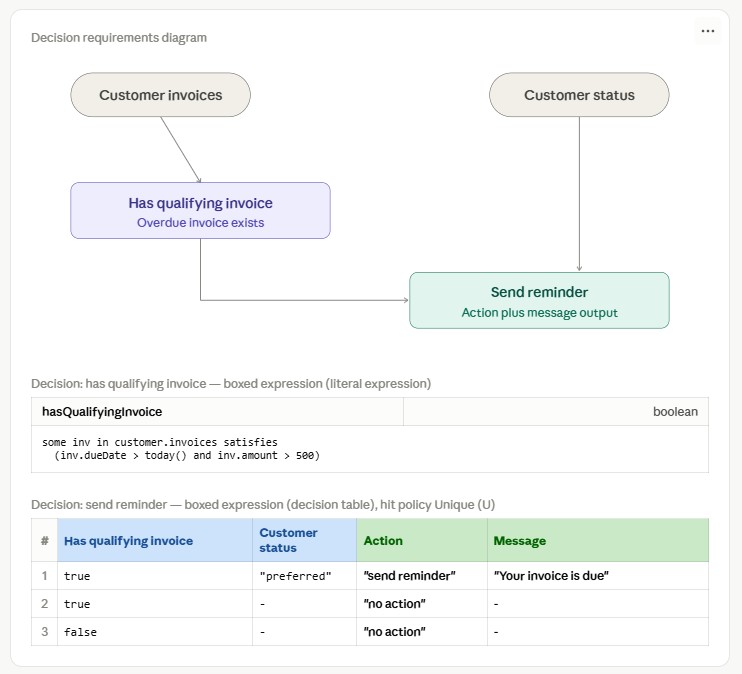
The clearest way to see all of this is to model one real rule both ways:
If an invoice exists that is past its due date,
	has an amount greater than $500,
	and the customer's status is Preferred,
		send a reminder with the message
			"Your invoice is due"
Here's the DMN version - a Decision Requirements Diagram, a boxed literal expression for the collection check, and a two-output decision table:
And here's the same rule in Code Effects:
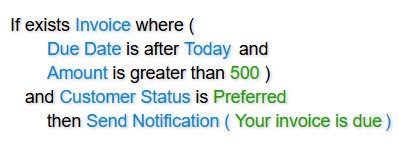
One detail in that screenshot is easy to miss and worth calling out directly: Today isn't a field. It's Invoice.Today() - a parameterless method on the Invoice type, not stored data. Code Effects' editor deliberately renders any parameterless method without parentheses, visually indistinguishable from a plain field, because a rule author has no reason to know - or care - whether "today" is a stored value or a computed one. To them, it's just today.
public class SourceObject
{
    [Field(CollectionSingleItemDisplayName = "Invoice")]
    public ICollection<Invoice> Invoices { get; set; } = new List<Invoice>() { };

    [Field(DisplayName = "Customer Status")]
    public CustomerStatus Status { get; set; } = CustomerStatus.Preferred;

    [Action(DisplayName = "Send Notification")]
    public void Send(string message) { /* Notification logic goes here */ }
}

public class Invoice
{
    [Field(DisplayName = "Due Date")]
    public DateTime DueDate { get; set; }

    public decimal Amount { get; set; } = 0;

    public DateTime Today()
    {
        return DateTime.Today;
    }
}

public enum CustomerStatus
{
    Preferred,
	Other
}
The DMN screenshot resolves the same value as a bare FEEL built-in, today(), rather than modeling it as a method on some sub-type the way the class above actually declares it. That's not a limitation of FEEL, which has its own date/time functions - it's a presentation choice: modeling Today as a method on Invoice, the way it's genuinely defined, would mean introducing another boxed expression or context layer just to resolve one value, roughly doubling the visual complexity of a diagram that already needs three separate artifacts to say what Code Effects says in one sentence. Code Effects absorbs that same underlying complexity into its reflected metadata and hides it behind a single, consistent visual rule. DMN sidesteps it in the diagram, because showing it honestly would make the notation the story instead of the rule.
Same Logic, Very Different Skill Requirements
Put those two artifacts in front of two different people and the practical difference shows up immediately. Nothing above is a capability DMN categorically lacks - collections, quantified conditions, and parameterized actions are all achievable in FEEL and boxed expressions. What differs is who can build and maintain it, and how long that takes.
With Code Effects, an intern can be handed the phone, have the rule's logic dictated to them by a lead who's on a business trip, and have a working rule built in minutes - because the entire thing reads as one sentence in plain business language, with no second syntax to learn and no separate diagram to reconcile it against. With DMN, the identical business logic - the moment it touches a collection, a computed value, or a parameterized action - requires someone who can write and verify FEEL, understands which boxed expression type the logic needs, and can trace a DRD to make sure a new node's inputs and outputs line up correctly. That's not an intern's job over the phone.
In most organizations that take DMN seriously at that level of complexity, it's a dedicated modeling or BA function with its own review cycle.
Same business outcome, same underlying rule - a completely different bus factor to get there.
What DMN Is Actually Good At
DMN earns its place when a decision genuinely fits a table: a fixed set of input columns, a fixed output, and rows a business analyst can read and validate without help. A DMN conformance level 3 implementation supports the full Friendly Enough Expression Language and boxed expressions, with fully executable decision models - and because it's an OMG standard rather than a vendor's proprietary syntax, it plays well in conversations with auditors and regulators who want to see decision logic in a format they can point to independent of who built the software.
Where Decision Tables Start to Strain
The trouble starts when the business logic isn't one decision anymore. A few concrete places this shows up:
Conditions that aren't table cells. A DMN table cell holds a FEEL expression - a comparison, a range, a simple function call. It's not built for a condition that needs to invoke an arbitrary method with its own parameters and return value as part of the evaluation. Code Effects rules aren't bounded by a cell: a condition can be a direct comparison or a call to any public .NET method, and a rule can be as simple or as layered as the logic actually requires.
Collections and existential checks. "Does a matching item exist in this collection" is common business logic - overdue invoices, flagged transactions, expired documents - and DMN can express it, but only by stepping outside the table entirely into a quantified FEEL expression (some x in collection satisfies ...), modeled as its own boxed expression and its own decision node feeding the table that actually resolves the outcome. See the worked example above: what's one native clause in a Code Effects rule sentence becomes a second artifact in DMN, with its own name, its own type, and its own place in the DRD.
Decisions that depend on other decisions, informally. DMN handles decision-to-decision dependency through the DRD graph, which is a real strength for visualizing structure - but it also means every dependency has to be modeled as a formal graph node before it can be reused. Code Effects' reusable rules feature lets you save any evaluation-type rule (true/false, no side effects) and immediately use it inside other rules as though it were a Boolean field - no separate diagram, no DRD wiring, just picking it out of the same context menu you'd use for any other field. The tradeoff is that this convenience creates a real risk of circular references, so Code Effects' rule editor blocks a rule from referencing itself while it's being edited, and can walk the full reference chain during validation if you supply a rule-resolution delegate.
Grouped, ordered business logic beyond a single table. Real rule sets tend to cluster by business purpose - Risk Analysis, Credit Risk, Health History - and need to run in a declared, predictable order, sometimes stopping early once an outcome is known. That's a ruleset-level concern DMN doesn't really address; a DRD models dependency, not declared sequencing across groups. Code Effects rulesets are evaluated in the order rules are declared within a group, and groups run in the order they're submitted for evaluation.
Resolving multiple true results. This is the closest like-for-like comparison to make, and it's worth being precise about it. DMN bundles matching behavior and firing behavior into one named hit policy per table - Unique, First, Priority, Any, Collect, Rule/Output Order. Code Effects splits the same problem into two independent settings on EvaluationParameters: Scope (All requires every rule to hold, AtLeastOne requires just one) combined with ShortCircuit (stop evaluating once the outcome is decided, or run every rule regardless - useful when rules carry side effects you want captured even after the result is known). The four combinations map onto short-circuit AND, exhaustive AND, short-circuit OR, and exhaustive OR. It's not a direct feature-for-feature match to all six DMN hit policies - there's no built-in equivalent to Priority-by-rank or Collect-style output aggregation, and Code Effects doesn't attempt Rule/Output Order either, which in practice is the least-used DMN policy since it's about returning an ordered list of multiple outputs rather than a single decision. But for the AND/OR resolution that covers the overwhelming majority of real rule sets, the two-axis model is more explicit and composable than picking a single named policy off a fixed list.
Nested, plain-language logic. This is where the gap is largest in practice. Take a rule like this one, modeled in Code Effects' editor exactly as a lead might describe it out loud in a meeting room:
If
	(user status is Active and last access was more than 5 days ago) or
	(user role is Admin and his access level is 5)
		then
			grant access and
			log ("Access granted")
Else if
	user role is Support and
	user access level is { user last level + levels.min }
		then
			grant access and
			notify admin ("Support user granted access")
Else
	deny access and
	notify admin ("User access denied")
That's nested if / else-if / else branching, mixed AND/OR conditions, a computed threshold, and three distinct outcomes each pairing a decision with an action - and a non-technical reader can follow the actual business intent on first read. Reproducing the same logic in DMN would mean multiple linked decision tables or a denser boxed expression, plus a DRD to show how they connect, because a single DMN table is built around one row-per-condition structure, not free-form nested branching. This connects to a structural point worth being precise about: DMN decisions are explicitly designed to be deployed as stateless, side-effect-free decision services - the standard doesn't model "grant access and log it" as a single unit, because logging and notifying are actions, not decision outputs. In DMN, that logic has to be split: the decision table produces a value, and something outside it - a BPMN service task, application code - has to act on that value. Code Effects doesn't draw that line; a rule's conditions and its actions are authored together, in the same sentence.
The "no-code" chaining claim, examined honestly. DMN's DRD is often positioned as letting business users lay out what should be evaluated next without programming anything. That's true for the modeling step, but it doesn't extend to execution: something still has to invoke each decision service in the sequence the diagram implies, whether that's a BPMN engine calling decision services in order or custom orchestration code. Code Effects doesn't hide this trade-off either - it just moves it to a place a BA can reach. Because any public .NET method can be exposed as a rule action, a developer can build (once) something like an ExecuteRule(ruleId) or ExecuteRuleSet(ids) action that takes a rule or ruleset identifier. After that one-time setup, a business author can chain rule execution from directly inside the rule sentence itself, the same way they'd write any other action - no further developer involvement per chain. Both approaches genuinely need a development team to do initial setup; DMN's diagram doesn't remove that requirement, it just documents the intended flow more formally. Where they differ is what happens after setup: DMN's DRD is primarily a modeling and documentation artifact, while Code Effects' equivalent is directly authorable and re-chainable by a BA without returning to the diagram or the dev team each time the sequence needs to change.
AI-assisted authoring. This one isn't a DMN limitation so much as something entirely outside its scope - the spec has no concept of it. Code Effects' Prompt flag lets any rule field or method hand off part of the evaluation to any LLM (OpenAI, Anthropic, Gemini, or a self-hosted model) while keeping the rest of the logic deterministic. Adaptive Source goes further, letting the rule editor request its own menus - fields, methods, enums - on demand from your application at runtime, which means those menus can be generated dynamically, including from LLM output. Context Resetters then automatically clear any rule elements a prior change has invalidated. None of this has a DMN-tooling equivalent, because DMN's authoring model assumes a fixed, pre-modeled schema behind every table.
DMN Interoperability - And the Portability Myth
To be direct about where Code Effects stands today: RuleXML does not implement or convert to/from DMN, and there's no bundled import/export utility. Code Effects is currently gauging demand from its existing customer base for a RuleXML ↔ DMN conversion parser before committing engineering budget to it - so if DMN interchange with other tooling is a hard requirement for your evaluation, that's a fair question to raise directly with Code Effects rather than assume either way.
DMN's own pitch, though, deserves more scrutiny than it usually gets. "Vendor-neutral and interchangeable" is the headline selling point - a model built in one DMN tool should run in another, no rework required. In practice that promise is a lot thinner than the marketing suggests, and this isn't a competitor's talking point - it's a question DMN's own practitioners raise. Bruce Silver, one of the most established voices in the DMN community, has pointed out the exact problem directly: established vendors already have their own fully-built expression languages and data-manipulation approaches, so once a tool layers its own extensions onto FEEL or its own equivalents onto boxed expressions, what's actually interoperable beyond the DRD shapes themselves? Is the XML interchange format even compatible with those vendor extensions? Those are open questions from inside the standard's own advocacy, not manufactured skepticism.
It shows up in vendor documentation, too. Red Hat's own DMN tooling docs are explicit that DMN decision tables and the platform's native Drools decision tables are different assets, with different syntax requirements, and are not interchangeable - meaning a DMN-conformant vendor still maintains a separate, proprietary format alongside DMN for real production work. When the reference implementations keep a proprietary fallback next to the "portable" format, portability is considerably narrower in practice than "export from one tool, import into another."
It's also worth noting that DMN portability has a caveat even within its own ecosystem beyond that: the link between a BPMN process and a DMN decision it invokes has never been standardized by OMG, so that connection is vendor-specific regardless of which DMN-compliant tools you use. "Standard" doesn't mean every integration point is guaranteed portable - and Code Effects has never claimed cross-vendor portability RuleXML doesn't actually deliver, which is arguably the more honest position of the two.
Current DMN engine implementations tracked by the DMN Technology Compatibility Kit include IBM's Business Automation Manager, Trisotech's Digital Enterprise Suite, an open-source Rust runtime, a Go-based engine, and Camunda's engine - a landscape that's either Java/JVM-native or written as a standalone service, not .NET-native. A .NET or C# team adopting DMN today is either bridging to a JVM-based engine over REST or picking one of the newer, smaller non-JVM implementations with a shorter track record. Code Effects ships as NuGet-distributed .NET assemblies with no JVM or external service dependency anywhere in the stack - a difference that matters less for the decision-modeling question and more for the "what do we actually have to run and operate" question.
The "No Objects at Design Time" Claim Is Already Outdated
Part of DMN's design philosophy leans on the idea that a decision model only needs to describe data - input names and types - without binding to a concrete, hand-declared class at design time. That was a genuinely useful idea when DMN was first published in 2015. It's no longer a differentiator, and hasn't been for years.
Code Effects introduced FlexSource around the same period DMN itself was taking shape, letting rules be authored against dynamic, schema-less, or runtime-defined data with no fixed class behind them at design time. The newer Adaptive Source goes further still, letting the rule editor request its own menus - fields, methods, enums - on demand from the application at runtime, so the data surface a rule author sees can be generated dynamically rather than declared up front at all. The era when a business rules engine could only work against hard-declared classes ended a long time ago. DMN's "you only need to describe the data" pitch describes a problem Code Effects solved on its own timeline, and has since moved well past.
Why Code Effects Doesn't Use Decision Tables
This isn't a stance taken against DMN specifically - Code Effects' first major version shipped in 2009, years before DMN's first formal OMG release. It came out of the founding team's own background in business management, watching business analysts struggle with the decision-table-based tools that were effectively the only option at the time. Decision tables, whatever standard or vendor they came from, were - and largely still are - a programming-heavy format dressed up as a business-user tool: rows, columns, cell-level expressions, and hit-policy semantics that read more like a spreadsheet built for a compiler than a sentence a business owner would actually say. That gap between "marketed as no-code" and "still requires thinking like a programmer" is specifically what Code Effects' sentence-like, menu-driven rule editor was built to close, and it's the same gap this comparison keeps landing on: DMN inherited the table paradigm rather than replacing it.
The "It's Free" Myth
DMN itself carries no license fee - that part is true. But a decision model of any real complexity in DMN isn't just a table; it's a DRD, one or more boxed expressions in FEEL, a hit policy chosen and verified, and a review process to confirm all of it is correct and non-overlapping. That review process needs people who can read FEEL and reason about a DRD. In practice, that turns "managing business decisions" into an undertaking with its own budget, its own business analysts, and its own sign-off chain touching most of the organization - not a feature the business team just handles on its own.
Business rules and decisions should be another item on a business team's to-do list - another menu item in an admin console, sitting alongside everything else they already own. That's what it is with Code Effects: the license cost is visible and known up front, and everything after that - authoring, testing, changing a rule the moment the business changes - happens inside the same team, the same tool, the same day, as shown in the two screenshots above. With DMN, the standard is free; the organizational machinery required to use it safely at any real complexity is not. Measured on total cost - time, headcount, review cycles, and testing - handling the same rule shown earlier in Code Effects is the cheaper path end to end, even with a license fee attached.
Where DMN Genuinely Wins
If your organization needs a single, standardized, auditor-legible decision table, or already has BPMN process tooling (Camunda, Trisotech) where a DMN decision service is the natural companion artifact, DMN is a mature choice with a real ecosystem and formal conformance testing behind it.
Where Code Effects Wins
Once the logic outgrows a single table - conditions that need real method calls, rules that reference other rules, grouped rulesets with declared ordering, or AI-assisted authoring - Code Effects picks up where DMN's scope ends. It's not a DMN replacement in the standards sense; it's a different category of tool aimed at teams whose decision logic was never going to fit cleanly in a table to begin with, built natively for .NET with no JVM bridge required.
FAQ
Does Code Effects support DMN? Not natively. Code Effects uses its own open RuleXML format. A RuleXML-to-DMN conversion utility is under evaluation based on customer demand but isn't currently available.
Is DMN better than a business rules engine? Neither is universally "better" - they solve different scopes. DMN is purpose-built for single, tabular decisions with a standardized notation. A full BRE like Code Effects is built for interdependent rules, arbitrary condition logic, reusable rule components, and ordered rulesets that don't reduce to one table.
What is a DMN hit policy, and does Code Effects have an equivalent? A hit policy (Unique, First, Priority, Any, Collect, Rule/Output Order) governs what happens when multiple rows in a DMN table match at once. Code Effects addresses the same problem with two independent settings - Scope (All/AtLeastOne) and ShortCircuit (true/false) - covering AND/OR resolution with or without early exit. It doesn't replicate Priority ranking, Collect-style aggregation, or Rule/Output Order.
Can DMN model conditions that call custom methods? DMN table cells hold FEEL expressions, which are more constrained than arbitrary code. Code Effects conditions can directly invoke any public .NET method with its own return value, alongside plain value comparisons.
Does DMN support reusing one decision inside another? Yes, via the Decision Requirements Diagram, where one decision's output feeds another. Code Effects has a related but lighter-weight mechanism: any evaluation-type (true/false) rule can be saved and reused directly inside other rules as an ordinary Boolean field, without building a separate dependency diagram.
Is DMN vendor-neutral? Yes, that's its core value proposition - it's an OMG standard rather than proprietary rule syntax. In practice, most mature DMN tooling (Camunda, Drools/KIE, Trisotech, IBM BAMOE) is Java/JVM-centric, which matters for .NET teams evaluating cross-platform integration cost.
Is Code Effects a replacement for DMN? Not in the standards sense - Code Effects doesn't implement or claim DMN compatibility. It's a full business rules engine aimed at logic that's outgrown what a single decision table or DRD can express cleanly.
Does BPMN + DMN cover multi-step business logic the way Code Effects does? Partially. BPMN can sequence process steps and invoke DMN decision services along the way, but the BPMN-to-DMN link isn't itself standardized by OMG - it's vendor-specific. Code Effects handles ordering and chaining directly through ruleset sequencing, Loop Mode, and rule-to-rule invocation, without a separate process-modeling layer.
Does DMN support AI-assisted rule authoring? No - it's outside the scope of the DMN spec entirely. Code Effects has native AI integration via a Prompt flag on rule fields/methods, plus Adaptive Source and Context Resetters for dynamic, context-aware rule authoring.
Is Code Effects .NET-native like some DMN engines are Java-native? Yes. Code Effects ships as NuGet-distributed .NET assemblies with no JVM dependency. Most mature DMN engines (Camunda, Drools/KIE, Trisotech, IBM BAMOE) are JVM-based or run as standalone services a .NET application would call over REST.
When should a team move from DMN to a full BRE? When decision logic stops being expressible as one table or one DRD - when conditions need real method invocations, when rules need to reference other rules directly, when multiple rule groups need declared evaluation order, or when rule authoring needs to be AI-assisted or embedded in a customer-facing UI rather than modeled by an analyst in a separate tool.
Can DMN express nested if/else-if/else logic the way a programming language can? Not directly in a single table - a DMN decision table is built around one row-per-condition-set structure. Nested, mixed AND/OR branching with computed values typically requires multiple linked tables or a dense FEEL boxed expression, plus a DRD to show how the pieces connect. Code Effects can express the same nested logic as a single, plain-language if/else-if/else rule.
Can a DMN decision table include actions like sending a notification or writing a log entry? No - DMN decisions are specified to be stateless and side-effect free; the decision table only produces an output value. Actions have to be modeled separately, typically as BPMN service tasks that consume that output. Code Effects rules can bundle conditions and actions (grant, deny, log, notify, invoke another rule) together in the same authored rule.
Is DMN really "no-code" for chaining decisions? Only for the modeling step. Something still has to execute the decisions in the sequence a DRD implies - a BPMN engine or custom orchestration code - which requires developer setup regardless. Code Effects has the same one-time developer requirement, but after that, a business author can chain rule execution directly from within a rule's own actions, without returning to a developer for each change in sequence.
Why doesn't Code Effects use decision tables? Code Effects predates DMN's first formal release - its first major version shipped in 2009. The sentence-like rule editor came directly out of the founding team's experience in business management, watching business analysts struggle with the decision-table format that was the standard option at the time.
Does DMN support collections and existence checks? Yes, through FEEL - the some...satisfies quantified expression, list-typed inputs/outputs, and the Collect hit policy for gathering multiple matching rows. But this logic can't live inside a decision table cell; it has to be pulled out into a separate boxed expression (typically a literal expression) and modeled as its own decision node in the DRD. Code Effects expresses the same "does a matching item exist in this collection" logic as a single native clause inside the rule sentence itself.
Is a decision table the only way to define logic in DMN? No. A decision table is one of several boxed expression types DMN defines - literal expression, context, relation, invocation, function definition, and list are the others. Any DMN decision node's logic is some boxed expression; the table is simply the most readable and auditable one, which is why it's the default choice whenever logic can be flattened into rows. The moment logic can't be flattened - a quantified check over a collection, for instance - authoring shifts into FEEL, which is a real expression language a business user typically can't read or verify.
Is DMN's interchangeable format actually portable between vendors in practice? Only partially. The DRD shapes and core semantics are standardized, but once a vendor's tooling layers on its own expression-language extensions or proprietary decision-table variants, cross-tool portability narrows considerably. Some DMN-conformant platforms maintain an entirely separate native rules format alongside DMN for real production use - Red Hat's own documentation is explicit that its DMN tables and its Drools-native tables aren't interchangeable - which is a practical admission that DMN alone doesn't cover everything a serious implementation needs.
Is DMN really free to adopt? The specification itself has no license cost, but any DMN implementation beyond simple flat tables requires FEEL literacy, DRD design discipline, and a review process to keep boxed expressions correct - typically a dedicated BA/technical function with its own budget and sign-off chain. The total cost of ownership includes that organizational overhead, not just tooling license fees.
Does Code Effects' FlexSource or Adaptive Source do anything DMN's data model doesn't? Yes. DMN's design assumes decision logic only needs to describe data shapes at design time, without binding to a concrete, hand-declared class - a reasonable idea when DMN launched in 2015, but not unique anymore. Code Effects' FlexSource (introduced around the same period) and the newer Adaptive Source let rules be authored against dynamic, schema-less, or runtime-defined data, including menus generated on demand at runtime rather than declared up front - going well beyond what DMN's static input/output model attempts.